Create an Effective Stakeholder Engagement Strategy
How To Engage With Stakeholders
When working on a project, it is important to identify your stakeholders and their needs. Internal and external teams always have some level of interest or investment in the project and its results. However, every project is different, and so are the teams and people involved.
Some stakeholders may require positive or constructive feedback or access to additional resources to feel engaged. Those involved in collaborative procurement, meanwhile, may benefit from secure and scalable cloud collaboration tools, such as Kahootz, to enhance transparency, streamline decision-making, and improve outcomes. Others, meanwhile, may be able to lend valuable insights and problem-solving perspectives to a project but need convenient and accessible ways to become involved.
Therefore, it is crucial to develop an effective stakeholder engagement strategy for every project you undertake—one that helps you meet the diverse needs of your stakeholders and drives the project to success. With such a strategy in place, positive stakeholder engagement—and all of its benefits—becomes much easier to achieve. Without it, projects may face delays and other challenges.
However, the most effective engagement strategies for stakeholders involve more than words or ideas—they also use modern tools and solutions to facilitate communication and collaboration more easily. Tools like Kahootz’s secure cloud collaboration platform enable you to engage, inform, and consult with stakeholders safely and efficiently.
A stakeholder engagement strategy is a plan of action for how an organisation or entity engages with its stakeholders, that is, any individuals, groups, or teams that have some sort of influence over or interest in the project. This can include not just employees but also suppliers, partners, investors, customers, and members of the public.
Numerous stakeholder engagement examples involve different strategies depending on the industry or sector. These can include:
Healthcare: The NHS frequently conducts focus groups or advisory panels that involve members of the public to gather their feedback and inform decisions that lead to changes and improvements in healthcare services. It also engages in experience-based co-design (EBCD), in which patients and healthcare staff work together to develop new services or innovations.
Defence: The Ministry of Defence regularly collaborates with a diverse range of contractors, suppliers, and external partners, as well as other government teams and agencies, on its projects with Defence Share. It seeks input and insight from numerous stakeholders to shape its plans and policies, all while abiding by strict military-level standards of data privacy and protection.
Central Government: When determining policies and plans, central government entities often engage in inter-agency collaboration and with non-governmental organisations, businesses, and community groups to gather input and ideas, and to inform next steps. This input may be collected through meetings, surveys, etc.
Stakeholder engagement is also invaluable in the private sector. A business working on a new product, for example, can seek input from its customers to determine initial interest, engage investors through presentations and update meetings, and work with sales, marketing, and development teams, among others, to bring its ideas to fruition in the most effective way possible.
Public vs. Private Stakeholder Engagement Strategy
Stakeholder engagement techniques, objectives, and methods vary between the two sectors. In the public sector, objectives often centre around public welfare or service optimisation, with a focus on transparency and accountability. Meanwhile, in the private sector, the end goal is usually focused on profit, growth, and business success.
Public sector organisations often have a much broader range of stakeholders to engage, which can include local communities, the general public at large, elected officials, and NGOs. In the private sector, the range of stakeholders is often limited to internal teams (employees and shareholders) and external customers, suppliers, and investors, resulting in a more targeted strategy.
Common stakeholder engagement methods also vary between the public and private sectors. In the public sector, methods may include surveys, participatory decision-making strategies, council meetings, etc., while private sector entities might rely on customer feedback and investor meetings and document collaboration. But, while the means vary, the end goals are often similar: to engage people at all levels to help projects succeed.
Why have a strategy for stakeholder engagement?
Depending on the sector you work in, stakeholder engagement and collaboration can deliver more customers, better-formulated policies, well-managed project management, innovation, and numerous additional benefits. This is backed up by statistics – one HubSpot study found that 78% of projects with engaged stakeholders are successful, compared to just 40% with low levels of engagement.
So, while the concept of engaging stakeholders and building engagement strategies may be new or unfamiliar to you, it is something your organisation should not only consider but also invest in if you wish to succeed in the long term. A stakeholder engagement strategy ensures that you involve the necessary people and groups in the decision-making process within a company, agency, or non-profit organisation.
Including everyone who will be affected by your company’s decisions is a great way to build trust and uncover potential risks. It can lead to more successful project outcomes, whether introducing a new product or service, or implementing new policies and improvements to an existing concept.
What’s more, a stakeholder engagement strategy gives you a plan for establishing relationships with them throughout the entire project management lifecycle. That includes:
Initiation: The starting point of the project. The stage at which you lay out your plans for the project, define your objectives, set the project’s scope, etc.
Planning: The stage in which you prepare a detailed roadmap and timeline for how your project will unfold, highlighting important dates, delegating tasks, and allocating resources.
Execution: This is the crux of the project – the point at which you put your plan into action. Following your roadmap, the team begins work on the project, implementing your methods.
Monitor/Control: The best projects require continuous monitoring to track progress and make adjustments on the go, as needed.
Closure/Evaluation: The endpoint of a project. This is where you deliver the final results and analyse how the project went to make necessary adjustments for the future.
Learning how to engage with stakeholders during each of these phases will help you keep the project on track, leading to a more satisfying and valuable conclusion. It’s not always easy, but there are numerous strategies and proven tools available to help you. Discover how to transform stakeholder engagement in the public sector today with our helpful guide.
How do you manage stakeholder engagement?
Building a stakeholder engagement strategy requires planning, as many organisations discover when they first attempt to engage their stakeholders.
However, with more than a decade of experience helping organisations engage their stakeholders and numerous success stories working with esteemed organisations such as the NHS and Ministry of Defence, we know that the whole process involves five simple steps.
1. Identify your Stakeholder & Define Your Purpose
First, determine who your stakeholders are. As mentioned earlier, the term “stakeholder” applies to a broad range of individuals in both the public and private sectors. It can include employees, team leaders, investors, partners, suppliers, customers, members of the public, and more.
Utilise stakeholder mapping or identification tools and templates to help you list your various stakeholders and understand why stakeholder management is important for your business operations. It may also be helpful to segment them into groups based on their levels of interest in and influence on the project. Stakeholder segmentation enables you to tailor your stakeholder engagement strategy, utilising the most effective engagement methods for various groups.
2. Analyse Your Stakeholders’ Interest and Influence
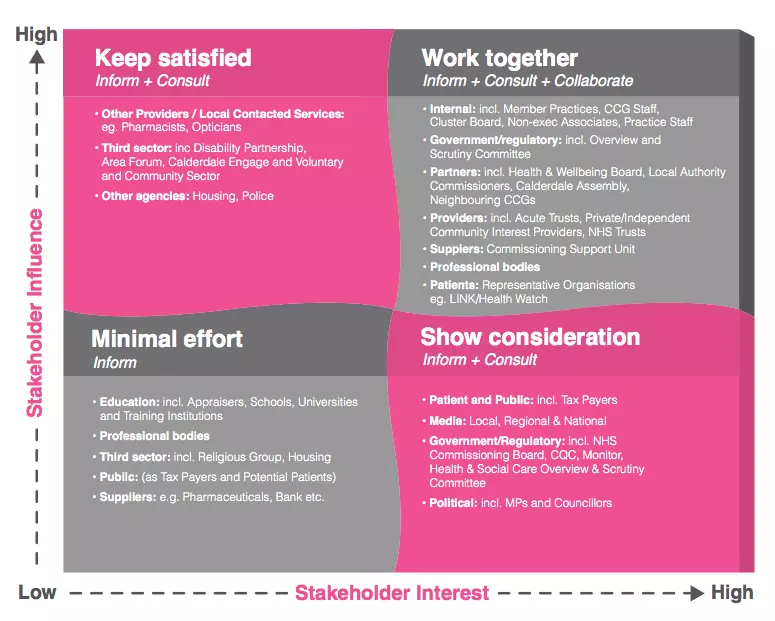
This step builds on mapping your stakeholders and categorising them, which is typically divided into four groups:
Low interest, low influence: These stakeholders mostly require information and updates, mostly.
High interest, low influence: These stakeholders will need to be consulted for insights.
Low interest, high influence: These are powerful, valuable stakeholders that need consistent engagement.
High interest, high influence: Essentially, partners on the project for you to collaborate with.
To map or designate stakeholders into one of these groups, you have to assess their levels of interest, influence, and involvement. Consider how much input they have with a project as it progresses, and how much the result impacts them.
Stakeholder analysis and mapping 1
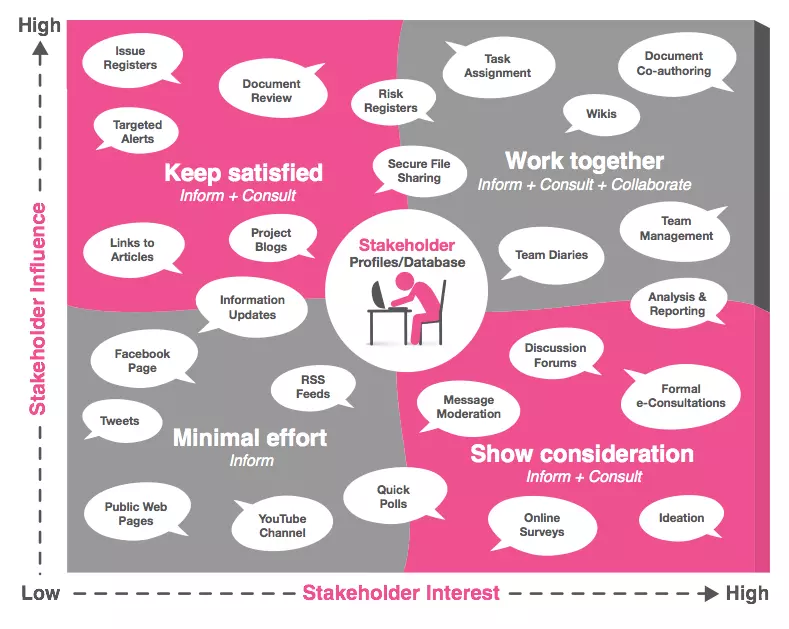
3. Develop a Tailored Engagement Plan
With your stakeholders identified and grouped, it is time to determine how you will engage them, not just initially or at some later stage, but throughout the project lifecycle.
Your stakeholder engagement plan must be tailored to suit the needs and interests of each group. For example, if the
NHS were developing a new mobile app for booking GP appointments, it could engage the public through feedback forms or surveys to determine which digital features they want most. However, working with development partners to create the application would require other methods.
Thus, it is essential to consider the diverse needs and interests of various stakeholder groups, as well as the value or insights they can offer, to select the most suitable stakeholder engagement methods.
Stakeholder mapping and analysis 2
4. Implementation and Managing Engagement
Next, put your stakeholder engagement strategy into action.
Use the tools and stakeholder engagement techniques outlined in your plan to communicate with stakeholders as the project progresses. This may include surveys, feedback sessions, focus groups, one-on-one meetings, progress updates, and various other methods.
Additionally, make sure to track and measure engagement success, as this is the only way to understand if your stakeholder engagement strategy is working or if it has room for improvement. Examine the value added through various engagement methods, the amount of feedback gathered, and the views of stakeholders regarding their involvement and sense of purpose in the project.
Finally, use the feedback you gather, along with the other metrics you use to measure engagement levels and strategy success, to evaluate and adjust your plan. You may find that certain stakeholder engagement methods are not providing the results you hoped, so you may want to adjust or switch to other options.
This is why it helps to have backup ideas as part of your stakeholder engagement strategy and to incorporate performance reviews into an ongoing process.
Communication Strategies for Different Stakeholders
In addition to utilising different stakeholder engagement techniques to engage various groups, you should also tailor your communications to suit each subset of stakeholders.
For example, the way you communicate with internal teams and employees may differ significantly from how you communicate with clients or investors. Again, it is a matter of considering the situation, needs, and desires of each group to tailor your strategy accordingly and achieve the kind of feedback, engagement, and results you seek.
With employees, for example, communication may focus on objectives, deliverables, and adherence to the project roadmap through regular feedback sessions and meetings.
Clients and members of the public, meanwhile, may be more interested in how a project is progressing and how the result will impact them. Social media and email campaigns are great ways to reach this broader audience.
When speaking with investors or shareholders, there may be more focus on raw data – facts and figures. Formal presentations and briefings are effective tactics for delivering this information concisely.
Examples of Stakeholder Engagement in Public Sector
Public sector entities face great challenges in engaging the many stakeholders who hold influence over or interest in the work they do. However, they can consistently find ways to overcome those challenges, often with the help of proven solutions, like the Kahootz cloud collaboration platform. Here are some stakeholder engagement strategy examples:
Ministry of Defence: The defence sector often involves entities at various levels, from the MoD to low-level suppliers, working together on projects and having to share key data to progress efficiently. Kahootz empowers the MoD to keep its partners and suppliers informed, up-to-date, and mitigate defence stakeholder engagement risks in the most secure way possible, thanks to its high-level data encryption.
Cabinet Office: The Cabinet Office has a big role to play in UK government work, which often involves multi-agency collaboration. However, teams across multiple agencies sometimes struggle to engage or communicate effectively. The Kahootz cloud collaboration platform simplifies this, bringing teams together in a strategic central hub.
Department of Health: During the COVID-19 pandemic, the Department of Health had to find a way to share sensitive medical data precisely and securely with key stakeholders, such as health directors and analysts, to track infection rates and develop vaccination strategies and general enterprise collaboration. Again, Kahootz proved invaluable, enabling secure knowledge sharing during a time of crisis.
Build a Smart Stakeholder Engagement Strategy for Project Success
Whether you operate in the public or private sector, the importance of engaging stakeholders should never be underestimated or downplayed. For long-lasting success and the most positive project outcomes, it is vital to build and deploy a stakeholder engagement strategy that gets results, backed by proven tools, like the Kahootz collaboration platform.
While the steps outlined in this post will get you off to a strong start when creating an engagement strategy for your stakeholders, they only scratch the surface of what’s possible. If you’re serious about reaping the benefits of stakeholder engagement, we strongly recommend you read our free guide, Transforming Public Sector Stakeholder Engagement. While focused on the public sector, it is invaluable for any organisation in any industry wanting to learn how to engage stakeholders.
Is Kahootz the right platform for you and your stakeholders? Try-before-you-buy with a no-obligation 30-day free trial.