
What the PHP security outage teaches us about protecting data
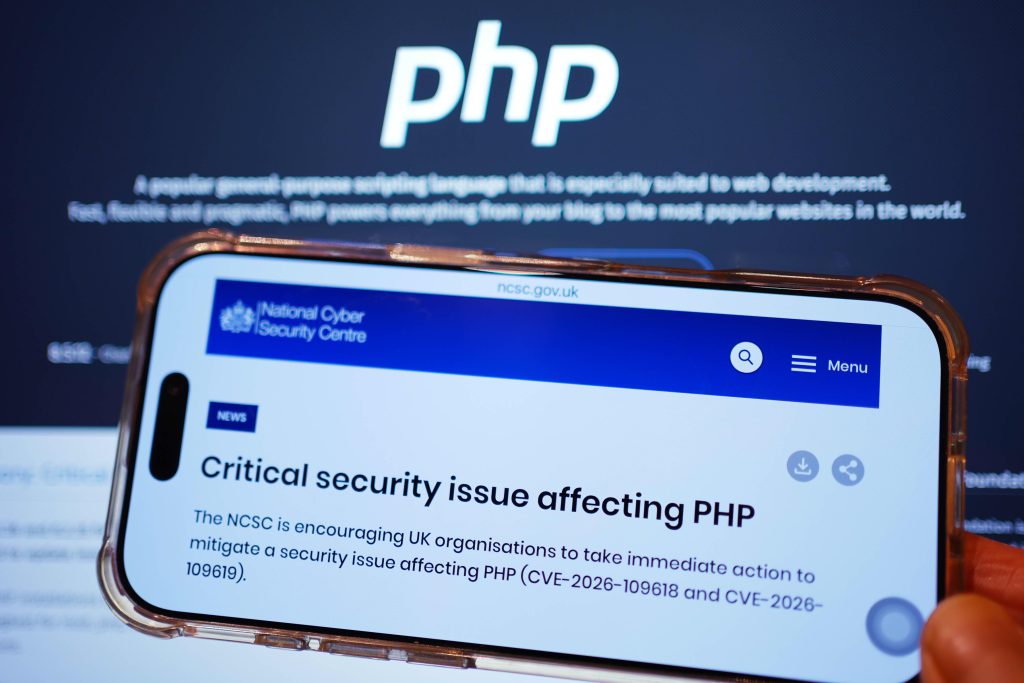
On 21 October 2026, organisations access to their websites, or took them offline altogether, while they applied urgent fixes for two critical vulnerabilities in PHP. The UK National Cyber Security Centre warned that the flaws could allow an unauthenticated attacker to execute commands on an affected web server. It advised organisations that could not patch or mitigate promptly to consider taking systems offline.
The disruption was serious, but it also exposed an important distinction: a service being unavailable is not the same as its data being compromised.
For organisations that depend on external partners, suppliers and public-facing digital services, the real test is broader than whether every webpage stays live. It is whether sensitive information remains protected, teams can make controlled decisions and trusted collaboration can continue through a separate, governed route. Kahootz doesn’t use PHP and was not affected by these vulnerabilities. Even so, the event is a useful test of what secure-by-design resilience should look like in practice.
What changed on 21 October 2026
The PHP project released emergency updates for two vulnerabilities, CVE-2026-109618 and CVE-2026-109619, each rated 9.2 under CVSS v4.0. PHP’s security notice urged all users to prepare to upgrade as soon as fixes became available. The NCSC alert published on 21 October explained that memory corruption could, under certain conditions, lead to unauthenticated remote code execution.
Remote code execution is especially serious because it can allow an attacker to run commands on a server without a legitimate account. The risk applied to PHP itself, so organisations needed to identify every installation, including PHP bundled inside third-party products, rather than checking only their main website.
Taking an affected service offline was therefore not evidence that it had been breached. In many cases, it was the recommended protective action while teams identified exposure, deployed fixed versions and checked for signs of compromise. That difference matters when leaders explain an incident to customers, staff and partners.
Why security and availability must be judged separately
Cyber resilience involves several objectives that can pull in different directions. Availability matters, but so do confidentiality and integrity. Keeping an unpatched internet-facing service online may protect short-term access while creating an unacceptable route to sensitive data or connected systems. Temporarily restricting access can be the safer continuity decision.
The right question during a severe vulnerability is not simply, “Is the service up?” It is, “Can we continue the critical outcome without weakening the controls that protect people, information and decisions?” For some public information pages, a static holding message may be enough. For an operational programme, incident team or supplier network, people may also need a trusted place to share updates, approve actions and maintain a record of what was decided.
This is business continuity, not disaster recovery. Disaster recovery focuses mainly on restoring technology and infrastructure. Business continuity is the ability to continue critical products and services during disruption. A secure collaboration environment supports the people, information and coordination part of that response. It does not repair an organisation’s affected servers.
The operational challenge sits between organisations
A vulnerability of this scale rarely stays inside one IT team. Security specialists need asset and exposure information. Service owners need to judge operational impact. Suppliers need to confirm which products contain the affected component. Communications teams need approved wording. Senior leaders need an evidence trail for decisions. Customers and partners need clear, proportionate updates.
Those people often work for different organisations and use different internal systems. Under pressure, the easy response is to fall back on long email chains, ad hoc messaging or hastily created file shares. That can scatter sensitive technical details, duplicate documents and make it difficult to tell who has seen the latest instruction.The collaboration requirement is specific: the right participants need controlled access to current information across organisational boundaries, without giving everyone access to everything. The workspace used for incident coordination should also avoid unnecessary dependency on the service being investigated.
What organisations should do now
The NCSC’s immediate advice remains the starting point: identify PHP installations, prioritise internet-facing systems, update to fixed versions, apply vendor mitigations where necessary and assess potentially exposed systems for signs of compromise. Beyond the technical response, organisations should use the event to test five continuity questions.
Map technology dependencies, not just named applications. Record the languages, runtimes, plugins, appliances and managed services that support critical processes. Ask suppliers how they will notify you when a shared component becomes vulnerable.
Separate public communication from operational coordination. A public website, support portal and incident workspace serve different purposes. Plan how each can be restricted or replaced without removing the team’s ability to coordinate safely.
Pre-authorise decision routes. Define who can take a service offline, approve a mitigation, accept residual risk and communicate externally. Capture those decisions and their evidence.
Prepare a clean collaboration environment. Maintain a governed space for incident plans, supplier statements, technical evidence, actions and approved communications. Review membership before a crisis.
Exercise the human workflow. Test how security, operational, legal, communications and supplier teams will work together when the main service or a familiar collaboration tool is unavailable.
Where secure collaboration fits
A continuity workspace should be treated as operational infrastructure, not a folder assembled after the incident begins. It should let an organisation invite named external participants, apply role-based permissions, maintain version history and preserve an audit trail. It should also make clear which information is current, who owns each action and which communications have been approved.
Because Kahootz is not built on PHP, it remained available throughout the response. Kahootz applies encryption to customer data at rest and protects communications in transit using TLS. Access is controlled and logged, while its cloud architecture is deployed across multiple availability zones. These controls are described in Kahootz’s security documentation and are managed through an ISO 27001-certified information security system.
The lesson is not that one platform removes every continuity risk. It is that important information should not inherit every dependency of the service it supports. Separation, least-privilege access and a rehearsed operating model give teams room to respond without trading confidentiality for speed.
How Kahootz can help
Kahootz provides secure online workspaces for teams that need to collaborate across organisational boundaries. In an incident or continuity setting, a workspace can hold response plans, technical updates, supplier confirmations, decision logs, risk and issue records, approved communications and recovery actions in one governed environment.
Granular permissions help limit sensitive material to the people who need it. Version control and audit records help teams establish what changed and when. UK hosting, encryption and independently assessed security controls give organisations a stronger basis for sharing sensitive operational information with partners than unmanaged email or consumer file-sharing tools. Kahootz supports coordination and information control during disruption. It does not replace patch management or disaster recovery for affected infrastructure.
The PHP event will not be the last time a widely used component forces rapid, difficult decisions. Organisations that prepare a secure collaboration route in advance will be better placed to protect information, coordinate across suppliers and restore normal service with a clear record of how they responded.
Source Notes:
National Cyber Security Centre, Critical security issue affecting PHP, 21 October 2026
Program, CVE-2026-109618 and CVE-2026-109619 records
PHP project, Upcoming Critical PHP Security Release and October 2026 releases
PHP security advisory for CVE-2026-109619
Kahootz Support, How secure is Kahootz, updated 4 February 2026